
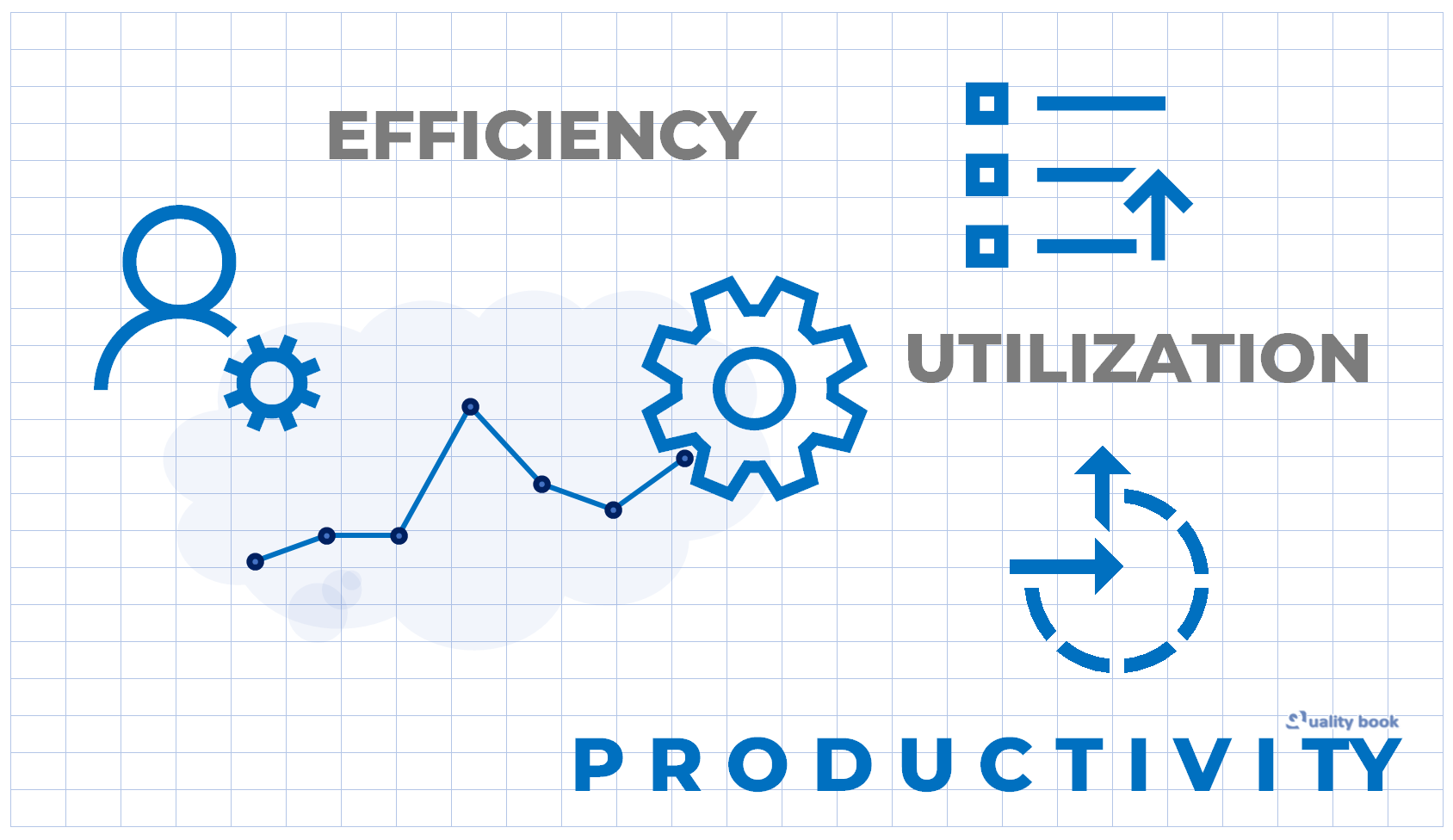
Productivity is actually sum of efficiency and utilization of the processes and resources. These may help to business to understand where business going?
Most people will recognize that the number of phrases making up management speak has increase significantly over the past decade or so. ‘Blue-sky thinking’ and ‘getting on message’ have become commonplace and probably have a case for inclusion in the Oxford dictionary, if they’re not already.
But this article is not intend to launch an attack on the increasingly growing array of terms at the disposal of present-day managers.
Languages across the world have, rightly so, been evolving for thousands of years and new words and phrases are popping up regularly. An individuals’ attempt to limit this would be fruitless and foolhardy.
Shifting Focus to Business Improvement Terminology
However, what I would like to focus on is one area of terminology: Business Improvement. In recent years words like ‘efficiency savings’, ‘productivity’ and ‘effectiveness’ are being used more and more by people from all levels within organizations in the context of improvement activities.
Typically, this boils down to meaning ‘doing more with the same resources’ or ‘doing the same with fewer resources. Often in this context, ‘resources’ means ‘people’.
Misuse and Confusion Around Key Terms
Sometimes I see the aforementioned terms being use interchangeably and, where that occurs, with insufficient thought as to what they really mean. In my experience this causes people to switch off from. What is a very important focus for businesses and undermines the impact of what people are trying to say.
This is a damaging shame as the concept is actually very simple to grasp and communicate.
What follows now is, in my opinion, how people within businesses should be thinking about defining the ‘efficiency’ (more on that in a minute) of teams of people.
The Three Core Concepts: Productivity, Efficiency, and Utilization
There are three terms that I refer to in the remainder of this article:
Productivity, Efficiency and Utilization.
Consider Productivity as being the result of multiplying Efficiency and Utilization and that leaves us with only the latter two terms to define.
Understanding Efficiency
Think about the service or product that your organization provides to customers. The price that customers pay will be influence by how much time you expect people to spend on the individual tasks that make up this service or product.
In a manufacturing context, the total assembly time that somebody is require to be doing something to the product will be calculate, and built into the end price.
In a service sector context this concept is no different. Productive Efficiency is the measure of how long people actually spend carrying out the tasks with no distractions compare with how long they should spend (or a calculating time base on standard operations).
If the amount of time allowed (therefore built into the price) for a particular task is 30 minutes.
Yet a person carrying out that task takes 60 minutes.
That person is said to be 50% Efficient at doing that task – 30 minutes divided by 60 minutes.
Understanding Utilization
Now think about all the activities that people do in a week. Sometime will be spent doing what the customer is paying for: Assembling a product, delivering a training course for a client, analyzing data or whatever it is that your company gets paid for.
The rest of the time will be spent doing things that you don’t directly get paid for. Attending meetings, producing internal reports, travelling, waiting for information or machinery to be repaired – the list is fairly exhaustive and contains activities that are familiar to all of us.
Let’s say that of the 40-hour week, a member of staff spends 20 hours actually working on something that is generating income for the business (regardless of their level of efficiency as previously define), and 20 hours engagement in the sorts of activities mention as above.
In this instance, the Utilization of that person is said to be 50%.
Linking Efficiency and Utilization to Productivity
If the scenario above were true. Then the overall Productivity of that person is 25% – this is 50% Efficiency multiply by 50% Utilization.
This effectively means that only 25% of the time. That person is being paid for is actually being use to generate direct income from clients.
Or, put another way, for every hour’s work you get paid by clients. You are paying that person for 4 hours ‘work’.
Why These Distinctions Matter
Apart from standardizing the language that people use and therefore encouraging increase understanding by the organization as a whole. The reason it’s relevant to distinguish between the component parts of Productivity. It is that different problems will require different solutions when striving for improvement.
If for example Efficiency is low. Then good benefits will likely come in the form of training, standardizing and continuously improving the way tasks are carry out.
Also, good physical organization of the workplace will allow tasks to be complete in a timelier fashion. If, however, the problem is one of low Utilization. Then initiatives like Information Centers will make meetings shorter and free up more time for staff to be working on tasks that generate income.
Tailoring Improvement Efforts for Real Results
Sadly, one size rarely fits all. An appreciation of what Productivity actually means, underpinned by a clear understanding of where your organization is experiencing problems. It will guide you more effectively to improvements that will add value where it’s really needs.